A Proper Diet is the Cornerstone of Good Health

CLick HERE to read more informations...

Housing For Health and Happiness

CLick HERE to read more informations...

Good Nutrition -- Cornerstone of Good Health

CLick HERE to read more informations...

HOW TO RECOGNIZE QUALITY PELLETS

CLick HERE to read more informations...

Forages Can Be An Important Part Of Your Guinea Pig's Diet

CLick HERE to read more informations...

Sunday, March 8, 2015

Cleaning the Cage

Cleaning the Cage


One of the nice things about the Cubes and Coroplast cage is the ease of cleaning. You should experiment to find the method that works best for you. Below are some recommended methods, in order by popularity.

What to do with the pigs during cage cleaning? In a good-sized C&C cage (usually 2x4 grids or bigger), you can scoot the pigs down to one end of the cage while you clean the other end. Or, you could give them floor time during cage cleaning time. Or, you could remove them to a temporary bin during cage cleaning time. Or you could give them to another household member for lap-time during cage cleaning time.
Method 1: Straight Bedding with Dust Pan
Description: bullet
1. Scoop out the bedding with a dust pan into a garbage can or waste bin lined with a large plastic bag. You may want to use a whisk broom to get the finer stuff out before spraying.
 
Description: bullet
2. Spray the sides and bottom of the cage with a spray bottle filled with 1/2 plain, white vinegar and 1/2 water. Wipe dry.
 
Description: bullet
3. Replace the bedding (and pigs).
That's it! No moving of the cage. No lifting of the grids creating a mess. No harsh, toxic cleaners are necessary. 10 minutes, providing you don't take extra time to play with the piggies.
Toss the bedding in the garbage, or your compost heap if you are using appropriate bedding, or spread on your garden, or put in your green recycle bin. Be aware that in many places, it is officially illegal to discard or recycle animal waste in the bins your waste company picks up.
Note: Vinegar -- not only is it a powerful antibacterial agent, it is also an acid. Urine is a base (alkaline). The neutralizing effect of the acid/base combination helps vinegar cut right through urine and urine buildup. If you have particularly stubborn areas, apply some vinegar full strength (which is still only a 5% solution). Rinse well.
Some people prefer to use a bleach solution. It should NOT be necessary. But, if you use bleach, use only a maximum of 10% bleach and 90% water and rinse VERY WELL.
If you are using the proper amount of bedding in your cage (1 to 1.5 inches) and changing it often enough, you should rarely have even damp spots on the bottom of your cage. If you do, you need to clean or spot clean more frequently or add more bedding or change the type of bedding you are using. Heavy urine at the bottom means too much urine on the top as well. Generally, the dirtiest part of the cage should be on the sides.
Ideally, you should give the pigs floor time while you are cleaning their cage.
How often should you clean the cage? There is no one, correct answer. Your cage should NEVER smell. On average, cages are completely cleaned once a week (bedding replaced, cage sides and bottom wiped clean). You will need to spot clean particularly wet spots an additional 1 to 2 times during the week. Some people spot clean every day. Some change the cage as often as every 3 to 4 days. It all depends on your particular setup, how many pigs you have, their urine and poop output and location, the age of the guinea pigs, etc.
Method 2: Add Newspaper Lining under Bedding
Description: bullet
Line the cage with Newspaper. Same technique as Method 1, but some people like to be able to "roll up" the newspaper with the bedding in it.DO NOT USE any kind of plastic liner. Even if you think the pigs can't get to it.
Method 3: Cleaning Flaps Option
Description: bullet
Make cleaning flaps in the cage. This might save you time depending on how your cage is set up. Using the grids, you create a door that can be swung open instead of securing it as a permanent part of the cage wall. Then you can push the bedding out of the cleaning door/flap into a waiting garbage can underneath.
This technique just replaces the dustpan approach above. We found that in reality, it takes as long to undo the grids as it does to scoop out the bedding in the first place. In other words, we don't take the time to do it; we just grab the dust pan instead.
In experimenting with this technique, the best results are achieved with only a one grid opening. The flap cut in the Coroplast should not be more than about 9" wide to eliminate spillage on the sides into an average large garbage can underneath.
Method 4: Cleaning with Allergies
Description: bullet
Take the cage outdoors to clean. IF you have severe allergy problems, cleaning the cage outdoors is a good idea. In that case, people have used the grids to also make a base for the Coroplast to sit on. That way they can lift the whole thing to take outdoors. That kind of setup also requires the grids to be firmly secured with cable ties at every connection.
Need a Bedding Recommendation?
At the Cavy Spirit rescue, we have to manage up to 200 square feet of Cubes and Coroplast cages. We need to minimize cost, minimize bedding weight, minimize cleaning time and minimize the frequency of cleaning. At the same time, we are extremely sensitive to the health of the guinea pigs as well as their quality of life. We must present a model of cavy care and our home must never ever smell like a cage or a barn. In addition, the bedding must be easy to obtain -- both for us and our adopters.
We have experimented with just about every kind of bedding possible. Our current solution for bedding is working great. We use about a 3 to 1 ratio of Aspen shavings if available (or kiln-dried pine when Aspen is unavailable) to CareFresh. We put a generous layer of shavings down first. We cover that with a layer of CareFresh. We always tamp it down lightly with a dust pan to get a more compact surface for the guinea pigs to run and walk around on. Because the shavings are covered with CareFresh, this eliminates any possible health risk from the phenols of the wood, especially if pine is used (even kiln-dried). But, more importantly, we believe it is important to cover pine as a quality of life issue for guinea pigs. Their sense of smell is much more sensitive than ours -- about 100 times more sensitive. The occasional whiff of pine may smell refreshing to us, but having one's nose in it constantly, kiln-dried or otherwise, would not be a choice one would make, guinea pig or human. Even with so-called "low or no-odor" pine that is kiln-dried, there is no mistaking that it is pine, even with our insensitive noses.
This combination of Aspen (or pine) and CareFresh, makes the bedding much more affordable than just CareFresh alone. Although, just CareFresh is still an excellent bedding choice if cost is not an issue.
Hay over the shavings would be an alternative to CareFresh over the shavings, but the hay would need to be replaced more often than CareFresh because it is not absorbent and should not be used as a bedding, per se. It would need to be changed almost daily, which makes it not a great solution from a time (and mess) point of view.
Some people use towels in a portion of a large Cubes and Coroplast cage and regular bedding on one end. If you are okay with frequently changing towels and laundering, that makes a good compromise on bedding cost as well.

Please give us more ideas!!!

~~~~~~~~~~~~~~~~~~~~~~~~~~~~~~~~~~~~~~~~~~~~~~~


Floor Time

Floor Time

Giving your guinea pig exercise and exploration time

Your guinea pig needs exercise and mental stimulation to stay happy and healthy. The smaller the cage the more important floor time is to the health and happiness of your guinea pig. Any cage size less than an unencumbered 10.5 square feet (or 2 x 4 grids) requires additional floor time. Guinea pigs in large cages will benefit from the additional change in environment, stimulation, and exercise. Even with large cages, your guinea pig cannot get the same quality of exercise and running as they can get with floor time. Lap time (holding and petting and snuggling with your guinea pig outside of it's cage) does not count as floor time. Lap time is good for you and your guinea pig, but does not give him the additional exercise and play time he needs.
The primary objective of floor time is exercise. When you first introduce your guinea pig to the concept of floor time, they typically just sit there and huddle, or they might scamper (or waddle) to the furthest, darkest corner and stay there. Don't worry, many people experience this behavior when starting floor time. This page has tips and suggestions for making floor time a success for your and your cavy.


In addition to giving your guinea pig exercise, you have an opportunity to play with and bond with your guinea pigs. Ideally, you should spend some time interacting with your guinea pigs during floor time, especially if you have only one guinea pig. A single guinea pig doesn't have a pal to run around and play with and so may take some extra encouragement and interaction from you.
Tip! The easier it is for you to set up for and clean up after floor time, the more often you will do it. Simple is better!  Floor time is a requirement for the life of your cavy. It can be challenging to continue to give your guinea pig proper floor time day after day, year after year. Making it easy to do and enjoyable is very important.

The Key to Our Success!
At Cavy Spirit, we have discovered a method that works with all of our guinea pigs. We chose to make our location semi-permanent. This makes it easier to do every day. You need to work with the natural tendencies and likes of your guinea pigs.

1. Bath mats
They like to run and hide in far away dark corners. Choose a corner like that as their home base. We picked a far corner in our dining room (or what used to be a dining room), under other tables (cages). We put a few rubber-backed bath mats over our white Berber (don't ask why) carpet. We cut the mats to fit around table legs so they could  easily be picked up and washed and put back down again. Be sure to have the carpeting cover the entire back corner!


2. Newspapers and Accessories
Then we put newspapers down over the carpet and added some familiar items. It's easiest to have a couple of duplicates of things from their cage--a wooden box, maybe a cozy, maybe a pigloo, maybe a tunnel, etc. Definitely add some hay and a food dish. You could also add an 'L-shaped couple of grids' so that you can attach a water bottle. Very important--be sure to put some Timothy hay down. That should keep them munching on that and not on other things.


3. Guinea Pigs
Now, just add pigs! The trick is to ALWAYS put them down on the newspaper, and let them wander off when they are comfortable. The newspaper gives them a natural border, very similar to their cage. They will be comfortable there and will treat it like their home base.


Cleanup
Remove pigs, roll up newspaper and toss! We leave the carpets down all the time. If you get bath mats to match your decor, who will know?

Protecting other areas
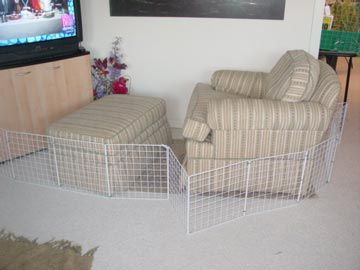
Our dining room borders a kitchen with linoleum and a hallway with tile. No pig has ever ventured willingly on either. But, in our office area, we have a chair that they love to hide under and is a pain to get them out from under. So, we do two things. We put a rug underneath the chair so that if we feel like letting them go under it, they are messing up the rug and not the carpet. And we have a bunch of grids cable-tied together to make a barrier which can be unfolded and put in place in about 3 seconds. When not in use, it just folds up and out of the way.


So while these guinea pigs are not litter-trained, per se, they in fact use the newspaper at their home base to potty, and we rarely pick up any stray poops and rarely break out the carpet shampooer because of floor time. Consistency is important for them to feel comfortable. Try to always use the same home base for floor time. Of course adding and changing toys and play items will keep it interesting for them.

For additional great ideas on floor time, please visit the Free Range page and see what others have done to make life very interesting for their piggies on the floor! Free range guinea pigs get to enjoy permanent floor time.
Choosing an area for floor time
The area that you choose for floor time will depend on a variety of factors. Here are some ideas with pros and cons of each.
 
Kitchen floor
Pros
Cons
Description: http://www.guineapigcages.com/images/53bullet2.gif
Easy to pig-proof.
Description: http://www.guineapigcages.com/images/53bullet2.gif
Usually no wires or outlets on the floor.
Description: http://www.guineapigcages.com/images/53bullet2.gif
Usually very few places to hide (except behind appliances).
Description: http://www.guineapigcages.com/images/53bullet2.gif
Easy to clean.
Description: http://www.guineapigcages.com/images/53bullet2.gif
Able to socialize with your guinea pig in the room.
Description: http://www.guineapigcages.com/images/53bullet2.gif
Won't forget about him/her.
Description: http://www.guineapigcages.com/images/53bullet2.gif
Usually easy to block off door way or entrance areas.
Description: http://www.guineapigcages.com/images/53bullet2.gif
Floors are usually linoleum or tile or wood, surfaces which are not ideal for guinea pigs.
Description: http://www.guineapigcages.com/images/53bullet2.gif
May be too busy of an area in some households.

Dining Rooms, Living Areas, etc.
Pros
Cons
Description: http://www.guineapigcages.com/images/53bullet2.gif
More space available for interacting with your guinea pig during floor time.
Description: http://www.guineapigcages.com/images/53bullet2.gif
Easier to watch your guinea pig while you go about your life.
Description: http://www.guineapigcages.com/images/53bullet2.gif
May take more preparation and clean up time.
Description: http://www.guineapigcages.com/images/53bullet2.gif
Not as easy to pig-proof.
Hallways
Pros
Cons
Description: http://www.guineapigcages.com/images/53bullet2.gif
Easy to pig-proof.
Description: http://www.guineapigcages.com/images/53bullet2.gif
Usually no wires or outlets on the floor.
Description: http://www.guineapigcages.com/images/53bullet2.gif
Usually very few places to hide.
Description: http://www.guineapigcages.com/images/53bullet2.gif
Easy to block off.
Description: http://www.guineapigcages.com/images/53bullet2.gif
Floors are usually linoleum or tile, surfaces which are not ideal for guinea pigs.
Description: http://www.guineapigcages.com/images/53bullet2.gif
You may not be as apt to sit down and interact with your guinea pig due to a lack of easy space.
Description: http://www.guineapigcages.com/images/53bullet2.gif
May be too much traffic in a busy household.
Bathroom floor
Pros
Cons
Description: http://www.guineapigcages.com/images/53bullet2.gif
Easy to pig-proof.
Description: http://www.guineapigcages.com/images/53bullet2.gif
Usually no wires or outlets on the floor.
Description: http://www.guineapigcages.com/images/53bullet2.gif
Usually very few places to hide.
Description: http://www.guineapigcages.com/images/53bullet2.gif
Easy to clean.
Description: http://www.guineapigcages.com/images/53bullet2.gif
Easy to cat and dog proof by just closing the door (but can lead to cons of forgetting, no interaction, and poor light and lack of fresh air).
Description: http://www.guineapigcages.com/images/53bullet2.gif
Floors are usually linoleum or tile, surfaces which are not ideal for guinea pigs.
Description: http://www.guineapigcages.com/images/53bullet2.gif
You may not be as apt to sit down and interact with your guinea pig.
Description: http://www.guineapigcages.com/images/53bullet2.gif
You might forget the guinea pig is in the room depending on the location.
Description: http://www.guineapigcages.com/images/53bullet2.gif
The room may not have natural light or air during the day.
Garage
Pros
Cons
Description: http://www.guineapigcages.com/images/53bullet2.gif
More space available.
Description: http://www.guineapigcages.com/images/53bullet2.gif
Might be easier to cleanup.
Description: http://www.guineapigcages.com/images/53bullet2.gif
Not necessarily a good environment in seasonal extremes (heat and cold).
Description: http://www.guineapigcages.com/images/53bullet2.gif
Might be drafty.
Description: http://www.guineapigcages.com/images/53bullet2.gif
Might be fumes from solvents and cleaners in the air.
Description: http://www.guineapigcages.com/images/53bullet2.gif
Not part of your daily living. 
Description: http://www.guineapigcages.com/images/53bullet2.gif
Might forget your guinea pig is "out there."
Description: http://www.guineapigcages.com/images/53bullet2.gif
You may not be as motivated to interact with your guinea pig.
Description: http://www.guineapigcages.com/images/53bullet2.gif
Do not run a dryer with your guinea pigs in the vicinity--too much of a change in temperature and humidity.
Outdoors  (only during good weather)
Pros
Cons
Description: http://www.guineapigcages.com/images/53bullet2.gif
Potential fun for the guinea pigs.
Description: http://www.guineapigcages.com/images/53bullet2.gif
You get the lawn trimmed.
Description: http://www.guineapigcages.com/images/53bullet2.gif
You MUST be present to watch for predators (sky and land--many people do not realize that crows, ravens, and hawks are deadly predators).
Description: http://www.guineapigcages.com/images/53bullet2.gif
The grass must be untreated  --  no pesticides & no fertilizers.
Description: http://www.guineapigcages.com/images/53bullet2.gif
They must be in an "enclosed" space. Never think they will "just stay" where you have them. 
Description: http://www.guineapigcages.com/images/53bullet2.gif
You must be more vigilant in looking for parasites which can be picked up outdoors.
Description: http://www.guineapigcages.com/images/53bullet2.gif
Only an option during good weather.
Description: http://www.guineapigcages.com/images/53bullet2.gif
They must have shade available as heat stroke kills many guinea pigs very quickly.
Poisonous Plant Links
There must be no potentially poisonous plants in the area. Here are some links to review for poisonous plants:
    
Beds, Bathtubs, Big Boxes, & Closets  (last resorts)
Pros
Cons
Description: http://www.guineapigcages.com/images/53bullet2.gif
Any miscellaneous place that is bigger than the cage is a potential area to allow your guinea pig to get some exercise.
Description: http://www.guineapigcages.com/images/53bullet2.gif
Depending on the area, there can be many potential negatives.
Pig-proofing the floor time area 
Safety First! There are two major dangers to guinea pigs during floor time, one is wires, the other is getting lost or stuck in places they shouldn't be. 
With wires, any plugged in wire represents an immediate lethal hazard. One bite through and they could be electrocuted. Many guinea pigs will chew on the wire for a bit before they might manage to bite through. In addition to the risk of electrocution is the risk of internal injury. For example, phone cords do not carry enough of an electrical current to kill a guinea pig, however, they have been known to eat little pieces of that wire causing themselves major internal injuries. It will tear up them up inside. Some guinea pigs will not chew any wires, but many will and you can't risk it.
Tight spaces represent a hazard that you do not want to deal with. You might be surprised about the spaces that a guinea pig can squeeze into, but may not be able to get out of. There are many stories, some hilarious, some sad of guinea pigs getting behind refrigerators, water heaters, built in shelving units, inside of furniture, inside walls, etc. Retrieving a stuck or missing guinea pig can be traumatic for you and them. It's better to block off areas they shouldn't be in.
Litter training for floor time (and cage time)
Many people want to know if it is possible to litter train a guinea pig. We wish we could offer a resounding, "Yes!" However, with guinea pigs, the degree of success of litter training varies greatly. Some can be litter trained. Others simply cannot. But there is a degree of success that you might be able to achieve. And your degree will vary. You should have the right expectations going into a "training" exercise. First, don't expect miracles overnight. Second, while you may be able get guinea pigs to urinate in an area that you designate, it is usually much more difficult to control the "bean" (or poop) location (the bean drop zone). The good news is, the beans are relatively easy to pick up or clean up, although they look messy. Also, even if you can get the urination to occur in one place, there may be the occasional accident.
 
Litter Training Tips and Tricks
Guinea pigs like to potty in private in the darkest, most inaccessible, most covered area possible--under furniture, in corners, and behind heavy, immovable objects. The trick is to work with that behavior. But be forewarned, they are not very consistent. They like to keep their caretakers busy cleaning up after them!
The following suggestions come from people who have had success with these methods. Others have tried to copy them, some successfully, many not.
Litter training program #1
  • Before you begin any elaborate efforts, put your guinea pig in your designated floor time area, and observe! Let them show you where they are want to go hide and potty.
  • Block off all the hiding places except one, or choose a corner that is the farthest away and the darkest--the most likely hiding and potty location.
  • Make a shallow litter tray with some bedding or litter from her cage with her scent on it (a little wet and with some poops). Or use a paper bag with a layer of newspaper in it with some bedding on top of that. Or just use a couple of thick layers of newspaper with some bedding on top. A paper bag on it's side offers an excellent solution. Guinea pigs like the privacy, the dark of it, and the "roof" over their head. And you have the added benefit of it being a snap to clean up. Simple fold and toss!
  • Hopefully, she will find this and go there to make her scent or mark stronger. 
  • Try to reward her with a little veggie treat.
  • With some luck, you may be able to reinforce this behavior.
Litter training program #2
  • Cover the floor with newspapers.
  • Slowly take them away. 
  • Hopefully, they will continue to potty on the newspapers, as that is what they are used to.
Litter training program #3
  • Spend a few weeks watching and scooting them into the litter pan every time they go and give them a treat for reward. 
  • If the litter pan is always around they might use it more, so try being consistent. Leave it in the cage with them and also bring it out at play time (if there is room in the cage).
  • It can be an ongoing process with the training never stopping. Every time you catch them going on the floor, scoot them into the litter pan and always reward them, especially when they go in the litter pan on their own.
Litter training variation #1
  • Make the litter box a big corner box, filled with litter (bedding material) and top it off with good a good hay (grass hay, meadow hay, Timothy hay). 
  • This gives them a reason to be there. They will munch on the clean perimeter.
Litter training variation #2
  • Use a covered box, perhaps a small animal carrier that is used for trips to the vet, also with litter and hay. Or, turn a plastic bathroom garbage can on its' side with some litter and hay in the back (easy to clean afterwards). The carrier approach has the added benefit of having your guinea pig used to being in it for traveling or trips to the vet, although the carrier may or may not be easy to clean. 
When and how often to give your guinea pig floor time
Guinea pigs tend to be most active at dawn and dusk, times when in the wild, the birds are not flying and they are safer (at least that's one theory). At the Cavy Spirit rescue, approximately 7 am and 7 pm seem to be popular lap running times. These times could also coincide with feeding times.
More important than when you offer floor time, is how often and consistency, and the answer is DAILY or as close to daily as you can possibly manage. Ideally, your guinea pig should get exercise every day. If you can give your guinea pig exercise twice a day, that would be great. An hour a day minimum, would be good. With cage size, the bigger the cage the better. The same idea applies to exercise, the longer the better. Some people provide a cage-free environment during the day, and place them in their cage for sleeping at night. Some provide several hours a day. Again, the more time the better.

~~~~~~~~~~~~~~~~~~~~~~~~~~~~~~~~~~~~~~~~~~~~~~~

Cleaning the Cage  

How to Sex Guinea Pigs 

Tower Nutrition for Guineapig 

How to Make a C&C Cage